

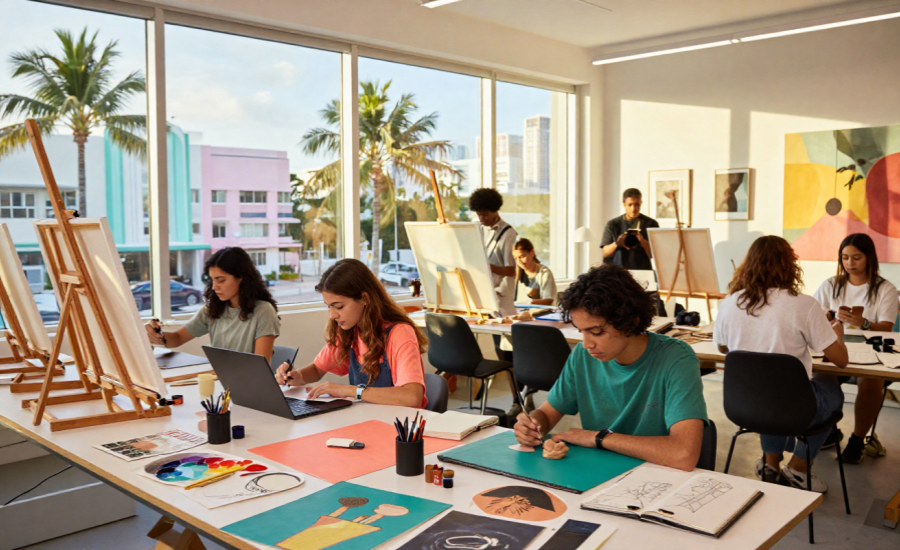
What happens when a child is given a blank canvas?
One child starts drawing immediately. Another asks, “What should I make?” A third experiments with colours, changes the idea halfway through and proudly creates something completely unexpected.
That difference is exactly what modern art education is beginning to embrace.
In 2026, art classes in Miami are not simply about learning how to draw a perfect portrait or paint within the lines. They are becoming spaces where students can experiment, make mistakes, solve creative problems and develop a personal artistic voice.
From the colourful energy of Miami’s neighbourhoods to its contemporary galleries, murals and design culture, students have plenty of inspiration around them. But the real skill is learning how to turn that inspiration into something uniquely their own.
Great artists don’t begin with all the answers. They begin with questions.
What happens if I mix these colours?
Can I create a painting without using a brush?
What would this object look like from another angle?
Curiosity encourages students to explore instead of simply following instructions. A good art class creates opportunities for these questions to emerge naturally.
Teachers can introduce an idea and then allow students to decide where it goes. This small change can make a big difference in how children approach creativity.
Instead of asking, “Did I do it correctly?” they begin asking, “What else can I try?”
There is no “undo” button on a physical canvas.
And that’s a good thing.
Digital tools have made it easy to delete mistakes instantly, but traditional art teaches an important lesson: sometimes a mistake can become part of the artwork.
A colour may look different from what a student expected. A shape may be slightly uneven. A painting may take an entirely different direction.
Rather than starting again every time something goes wrong, students can learn to work with the unexpected.
This is one reason hands-on kids art classes in Miami can be valuable. Students aren’t only developing artistic techniques; they are developing patience, flexibility and confidence.
Drawing isn’t simply about putting lines on paper. It’s about observation.
Students can learn to notice:
A simple exercise can make observation surprisingly fun: ask students to choose an everyday object and draw it without looking at the paper.
The result probably won’t be perfect.
But that’s not the point.
The exercise teaches students to slow down and really look.
Imagine giving students the same assignment:
“Create a city using only three colours.”
One student may paint buildings. Another may create a futuristic city. Someone else might turn the entire idea into an abstract composition.
There isn’t necessarily one correct answer.
Creative assignments like this encourage students to make decisions, overcome limitations and find different solutions to the same problem.
These skills extend far beyond art. Problem-solving, adaptability and independent thinking are valuable in school, future careers and everyday life.
Ask a group of young artists to paint the same subject and you’ll rarely get identical results.
That’s the magic of individual expression.
In 2026, students are surrounded by an enormous amount of visual content—from social media and digital illustrations to advertising, photography and AI-generated imagery. Developing a personal style is therefore more important than simply copying what is popular.
Students can experiment with different materials, techniques, subjects and artistic influences until they discover what feels natural to them.
The goal isn’t to become different just for the sake of being different.
It’s to discover what you want your artwork to say.
Technology is changing the creative world, but that doesn’t make traditional art skills irrelevant.
Quite the opposite.
Understanding colour, composition, perspective, proportion, texture and form gives students a foundation they can carry into almost any creative medium.
Whether they eventually explore illustration, animation, graphic design, architecture, fashion or digital art, these fundamentals remain useful.
The modern art student doesn’t necessarily need to choose between a pencil and a digital tool.
They can learn how to use both.
Art can be personal, but it doesn’t always have to be solitary.
Collaborative projects encourage students to listen to different ideas, communicate their own thoughts and compromise when necessary.
Imagine four students creating one large mural. Each person has a different concept, colour preference and way of working.
The challenge isn’t simply creating something beautiful.
It’s figuring out how four creative minds can contribute to one finished piece.
That’s a powerful lesson in teamwork.
Perhaps the most important creative skill is resilience.
Not every painting will be a masterpiece.
Not every sketch will work.
Not every idea will look as good on paper as it did inside the student’s head.
And that’s completely normal.
Art classes can teach children that creative growth isn’t about getting everything right the first time. It’s about creating, evaluating, changing, experimenting and trying again.
Create. Experiment. Repeat.
That cycle is where improvement happens.
A New Way to Think About Art Education
The best art education isn’t necessarily the class where every student leaves with an identical, perfectly finished project.
It’s the class where students leave with more questions than they arrived with.
They want to try another technique. They notice interesting colours on the way home. They see shapes in buildings differently. They feel comfortable making mistakes.
For young artists in Miami, the city’s diverse visual culture provides an exciting backdrop for this kind of exploration.
And in 2026, perhaps the biggest goal of art classes in Miami isn’t creating the perfect artist.
It’s helping children become curious creators who aren’t afraid to experiment.
Because creativity doesn’t grow when we wait for the perfect idea.
It grows when we pick up the pencil, open the paint, make the first mark—and see what happens next.

Sofia Art Academy is a classical-style private art school, provides great opportunity to study with classically-trained master-teachers the fundamentals of classical drawing and painting, to colorful stylized composition.
Sofia Art Academy of Miami 17395 N. Bay Rd. Suite 203 Sunny Isles Beach Miami, FL 33160
Copyright Sofia Art Academy © 2024, All rights reserved.
Designed & Developed By CODE4SURE